
CoMPSS: Maintaining Women on Opioid Substitution Treatment in Wartime
Deployed in five cities since 2024, the CoMPSS project combines medical care, psychosocial support and social assistance to limit treatment discontinuity among women on opioid substitution treatment, in a context of prolonged conflict.
Since the start of Russia’s full-scale invasion of Ukraine, continuity of long-term treatment has become a central challenge for the health system. Opioid agonist treatment (OAT), a pillar of harm reduction and of HIV and tuberculosis prevention, has remained continuously available. However, access to services and continuity of care pathways remain fragile, particularly for women.
Women on OAT accumulate multiple vulnerability factors: parental responsibilities, disproportionate stigmatisation compared to men, increased exposure to gender-based violence, economic precarity and mental health disorders. In a context of prolonged war, these factors directly affect treatment adherence. Care interruptions are less related to drug availability than to the inability, for some women, to maintain regular follow-up.
It is in this context that the CoMPSS project (Gender-Oriented Medical and Psychosocial Services) operates. The project is implemented by the Ukrainian community-based organisation Alliance for Public Health, in partnership with VONA, the Ukrainian network of women who use drugs, and is funded by L’Initiative – Expertise France.
An Integrated Approach to Reduce Treatment Discontinuity
Implemented between 2024 and 2027 in five cities – Kyiv, Lviv, Odesa, Kryvyi Rih and Dnipro – with a budget of EUR 1.5 million, the project targets women on OAT, mothers and caregivers, as well as survivors of violence. It combines medical care, psychosocial support and humanitarian assistance within an integrated framework.
Service delivery is notably organised around so-called “Mother and Child” spaces, located directly within treatment distribution centres, allowing women to attend consultations with their children. Parenthood constitutes a major barrier to access and continuity of care: mobility constraints, trade-offs between medical follow-up and childcare, fear of judgement or administrative consequences. The co-location of services aims to reduce these barriers and limit treatment discontinuity. The model also integrates specific support for women exposed to violence and gender-based discrimination, identified as major drivers of care interruption.
Psychosocial support is systematically integrated into the programme. Depression screening is conducted upon entry. In the first quarter of 2025, 98% of women followed had been assessed; nearly three out of four presented symptoms requiring support, which was provided in the majority of cases. In a wartime context, where life trajectories are marked by displacement, disruption, human loss and prolonged insecurity, these disorders directly affect the ability to remain on treatment.
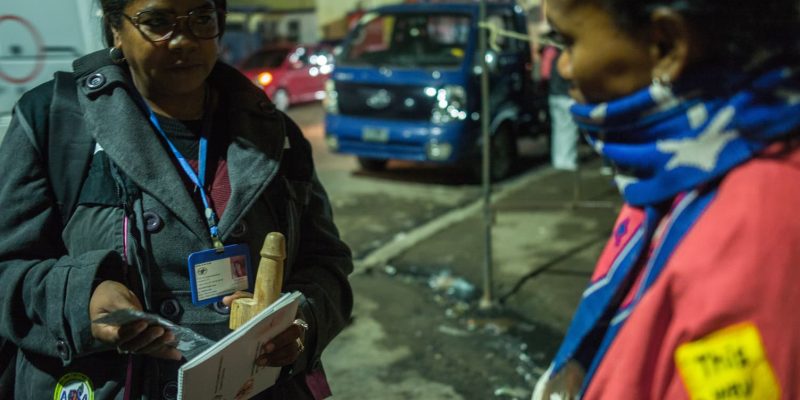
The project also relies on community-based approaches, particularly peer support. Women with lived experience of drug use and treatment accompany beneficiaries through their care pathways in a supportive and non-judgemental manner, facilitating access to services and helping to maintain links with the health system. Practical measures complement the model, such as transport support or adapted schedules, to take into account logistical and security constraints. The programme also relies on a network of doctors and specialists trained in the specific needs of patients who use drugs.
Stabilising Care Pathways Rather Than Expanding Coverage
At this stage, CoMPSS has supported 480 women, including 372 through integrated care combining medical services, psychosocial support and humanitarian assistance. This volume remains limited and reflects a model designed to support complete care pathways rather than short-term or one-off interventions.
The project contributed to 80 new OAT initiations, representing approximately 15% of new national enrolments, while operating in the equivalent of 2% of treatment distribution sites nationwide over the period considered. This indicates its capacity to remove certain access barriers for women previously distant from services.
Some prevention interventions were maintained or introduced, such as human papillomavirus (HPV) vaccination for women on OAT, illustrating the feasibility of integrating sexual and reproductive health services in a highly constrained context. Nutritional vitamin supplements for patients’ children were also introduced based on recommendations from the project’s mid-term evaluation.
Effectiveness Conditioned by Available Resources
The model implemented by CoMPSS relies on qualified human resources and close, intensive support. Its geographical coverage remains limited, and its sustainability depends on external funding. At this stage, the formal integration of these approaches into the national health system remains partial. A cost assessment of integrated services would help raise awareness within the Ministry of Health regarding delivery modalities and potential cost savings.
In Ukraine, prolonged war has redefined the conditions for the success of harm reduction programmes. Performance is no longer measured solely by access to treatment, but by the capacity to retain women in care despite the accumulation of social and psychosocial vulnerabilities exacerbated by insecurity, displacement and economic precarity. CoMPSS provides a concrete illustration of what such continuity requires, and of the limits faced by public health interventions when the institutional and security environment remains durably weakened.