
Working with and for sex workers — L’Initiative’s approach
Stigma, invisibility, violence, stock-outs of health commodities … sex workers remain among the populations most exposed to pandemics. For L’Initiative, responding to these challenges requires a cross-cutting approach combining community support, organisational strengthening, securing services and advocacy — a thread that runs through actions supported in Benin, Cameroon, Côte d’Ivoire, Ethiopia and Madagascar.
To guarantee the right to health for all, L’Initiative works with and for sex workers. This strategy rests on common levers: peer empowerment, consolidation of local organisations, securing care pathways and diversifying modes of intervention. At the heart of this support lies a conviction: protecting sex workers’ health is protecting everyone’s health.
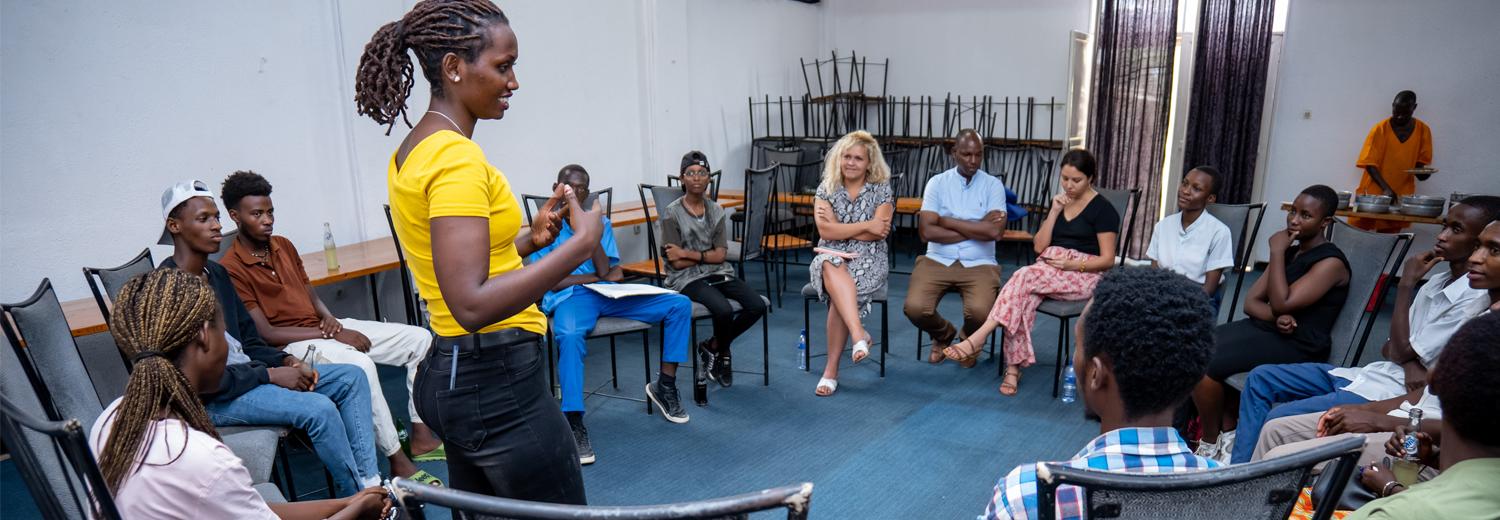
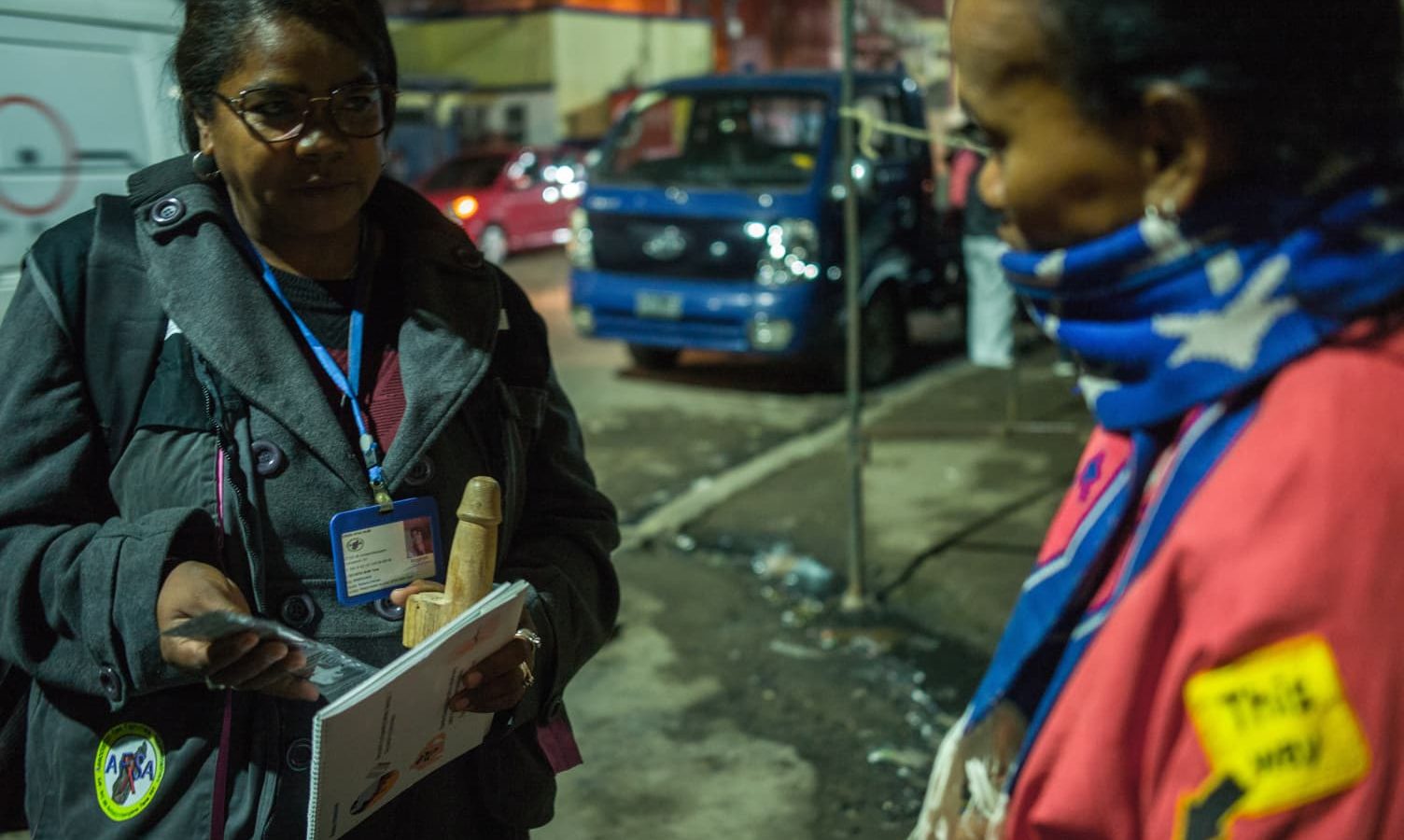
In Madagascar, along the Antananarivo–Tamatave corridor, the DESPS project, led by Médecins du Monde, illustrates the first principle: peer educators mobilised in outreach rounds, trained in prevention, listening and referral, break down barriers of fear and shame and enable better use of local health centres by reaching sex workers directly where they are.
Referring people to a health service, offering legal contacts, teaching how to negotiate condom use: these repeated, close-to-the-ground interventions exemplify L’Initiative’s chosen angle: acting from the field, with and through the people concerned.
The same approach guided support to NIKAT in Ethiopia, but along another axis: sustainability through actor structuring. In Ethiopia, the technical assistance funded by L’Initiative – Expertise France to the community organisation NIKAT, run by sex workers, enabled the production of a four-year strategic plan, adapted evaluation tools, a communications strategy and a donors mapping — concrete tools that strengthened this civil society organisation, notably by enhancing its credibility and resilience.
Here and there, strengthening governance, communications and resource mobilisation increases a group’s capacity to survive the volatility of international funding. But beyond that, the need for access and continuity of care resonates everywhere. Côte d’Ivoire and Cameroon underline a shared reality: the threat of poor access and service disruptions — worsened by funding withdrawals — calls for hybrid strategies. Decentralised services, health centres, mobile clinics and integration of specialised services (anal health, proctology, post-gender-based-violence care) make up an adaptive offer that preserves access to healthcare. Strengthening links between health centres and public institutions also improves referral pathways and the traceability of care journeys.
Concretely, in Abidjan, the POUVOIR+ project, led by Solthis, extends and broadens the gains of the first phase: better-equipped health centres, reinforced peer education, care for survivors of violence and sexual health services adapted to both cisgender and transgender women. Alongside the strengthening of care, the project focuses on empowering sex workers through innovative “self-help, self-care” workshops: self-gynaecology, reclaiming the body and work on representations, norms and beliefs. These programmes combine immediate responses and local mobilisation strategies to ensure continuity of care and the empowerment of highly vulnerable people.
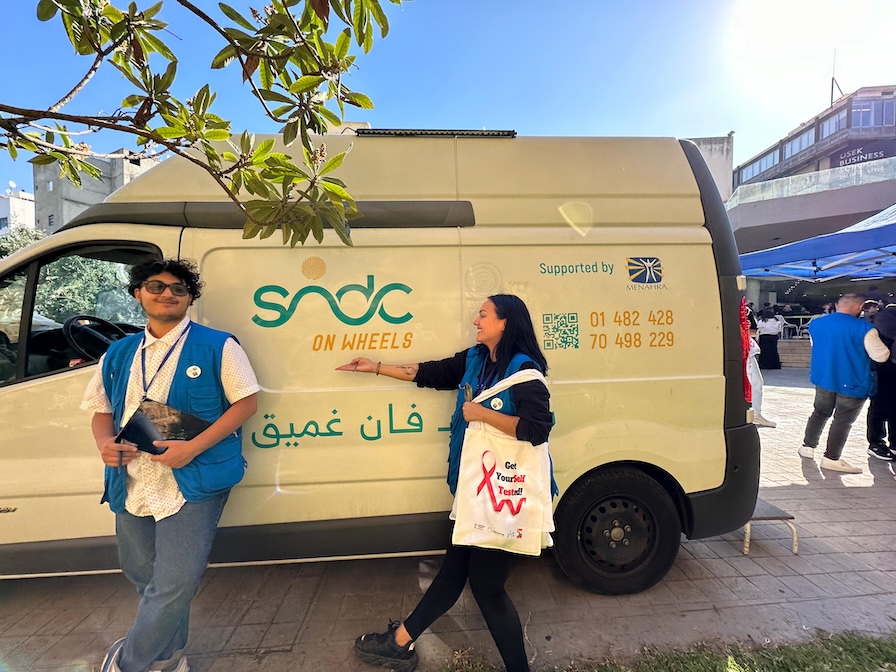
In Cameroon, Horizon Femmes via the SAGCO project complements this bundle of actions by bringing health closer to sex workers through mobile clinics, the training of gatekeepers and improved care for survivors of violence. The project highlights a simple truth: sex worker health requires multi-pronged responses — medical, psychosocial and legal — woven together with the authorities and the public sector.
Finally, support for small organisations via the SOFIA facility illustrates the other necessary side of the strategy: strengthening community-level actors who save lives with modest means. In Benin, SOFIA’s support to Association Solidarité recalls the pivotal role of flexible funding and tailored support: emergency funds, legal and psychosocial assistance, and mobilisation of female and male peer educators absorb individual (violence, complicated births …) and collective shocks.
Community anchoring turns aid into agency — an indispensable condition for making the right to health effective for everyone.
Linking these actions reveals a common logic: peer empowerment; institutional and civil society strengthening; maintaining and diversifying services; care for survivors and mental health; advocacy to secure resources and rights. L’Initiative supports a chain of effects: strengthening an association improves the quality and continuity of care; better-trained peers consolidate prevention; reliable data feed advocacy and stabilise support. At the heart of this chain is one conviction: protecting sex workers’ health protects everyone. When health commodities are available, when a health centre functions, when a local organisation can mobilise, when peers prevent infections, epidemic hotspots are extinguished — or never created — before they can threaten the whole population. It is this combination that today underpins a response capable of reducing vulnerability and disease transmission.
L’Initiative therefore invests not only in technical assistance and projects but also in an integrated — global, local, community-based and sustainable — strategy to assert the right to health for all, night after night, outreach after outreach.