

Ukraine: Four Years of Constrained Interventions – Lessons from an Evaluation in Wartime
24 February 2026 marks four years since the start of Russia’s full-scale invasion of Ukraine. Since 2022, the war has profoundly affected the Ukrainian health system, through the destruction of infrastructure, large-scale population displacement, fragmentation of care pathways, and the rapid evolution of health and psychosocial needs. Since the beginning of the war, more than 3,300 health facilities have been damaged or destroyed, while population movements – 6.3 million refugees and 3.3 million internally displaced persons – have durably complicated access to health services.
Present in Ukraine since 2014, L’Initiative strengthened and reoriented its engagement from 2022 onwards to respond to the immediate health impacts of the war. Interventions were implemented in support of Ukrainian and international actors already active on the ground, notably civil society organisations such as Alliance for Public Health, AFEW Ukraine, 100% Life ou TB People Ukraine, in coordination with national health institutions.
Between 2022 and 2025, this engagement took shape through eight interventions, for a total amount of EUR 9 million, combining the Ukraine Emergency Fund, technical assistance and project financing. The Ukraine Emergency Fund notably made it possible to rapidly support partners in maintaining continuity of HIV and tuberculosis care, access to harm reduction services, deployment of mobile and community-based services, and the gradual integration of mental health issues, in a context marked by sustained security instability and high operational constraints.
An independent, cross-cutting evaluation of L’Initiative’s actions in Ukraine was conducted from mid-2025 to analyse their performance, their adequacy in addressing urgent health needs in a context of prolonged war, and to draw operational lessons likely to inform future programmatic choices.
Measurable Results Despite a Health System Under Pressure
Between 2023 and 2024, monitoring data show a scale-up of operations, in a context characterised by infrastructure destruction, large-scale population displacement and persistent security instability.
- People benefiting from health services: 15,194 (2023) → 35,853 (2024)
In a country where a significant share of health infrastructure is no longer operational, this increase reflects the ability of the supported mechanisms to maintain and adapt access to essential services despite fragmented care pathways and forced population mobility.
- HIV – people initiated on antiretroviral treatment: 962 (2023) → 1,275 (2024)
At the same time, more than 1,000 people on treatment had an undetectable viral load in 2024. These data indicate that priority was given to continuity of care for people already engaged in HIV follow-up, in a context of high psychosocial instability. Resources were concentrated on quality of follow-up and treatment adherence, while the expansion of prevention and testing activities remained constrained by security and logistical factors.
- Tuberculosis – newly notified cases: 4 (2023) → 88 (2024)
In tuberculosis, observed results remain limited in volume and confined to specific segments, such as prison settings or paediatric tuberculosis. The evaluation invites these results to be read not as a population-level response, but as proof of feasibility in a context of prolonged war. They show what can be maintained, initiated or tested under constraint, without presuming rapid scalability within a health system under sustained pressure.
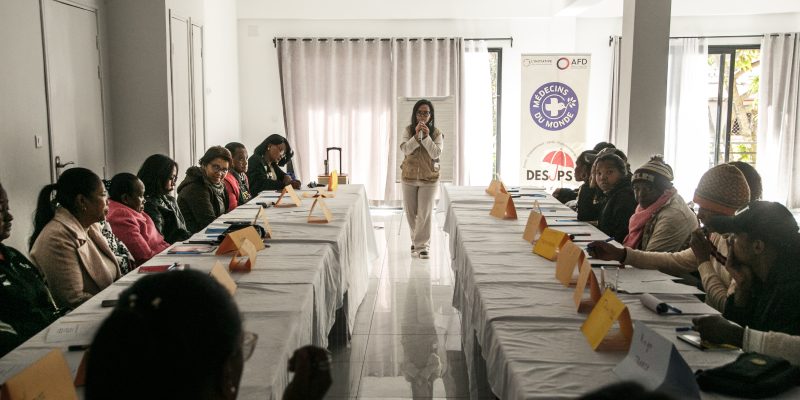
The evaluation results and analyses were presented during the Learning from the Field – Ukraine restitution event, organised with partners on 12 December 2025.
What the Evaluation Reveals
Financial and Operational Flexibility as a Condition for Efficiency
The evaluation highlights that intervention performance largely relies on the adaptive capacity of financing and implementation mechanisms. The Ukraine Emergency Fund enabled rapid budget reallocations, reduced administrative burden and continuous adjustment of activities, including in unstable areas. This flexibility largely explains partners’ ability to maintain services despite strong security and logistical constraints.
Observed results thus depend as much on actor commitment as on the design of the instruments mobilised. Logistical delays and access constraints occasionally slowed implementation, reminding that efficiency remains dependent on structural factors external to projects.
The evaluation nevertheless shows that this flexibility made it possible to articulate emergency response and system strengthening: mechanisms initially designed to address the crisis have, in some cases, contributed to structuring more durable responses.
Local Actors at the Heart of the Health Response
The second lesson concerns the central role of local actors in the operational effectiveness of interventions. In 2024, supported actions involved 6 civil society organisations, 21 public structures and 12 other entities, mobilising community-based, mobile and proximity approaches to reach particularly exposed populations, in a context of weakened health infrastructure.
The evaluation shows that, in several areas, service continuity relied almost exclusively on community actors, able to deploy mobile, proximity-based and peer-led approaches where public capacities were severely constrained.
This complementarity between local actors and international support made it possible to reach particularly exposed populations – young people, LGBTQIA+ individuals, people who use drugs, displaced persons. It was, however, built on fragile and heavily solicited human resources, immediately raising the question of medium-term sustainability.
Mental Health: From Blind Spot to Central Determinant
Four years of war have profoundly altered the conditions under which health interventions operate in Ukraine. More than 60% of people affected by the conflict report significant emotional distress. In this context, access to services, treatment adherence and continuity of care in HIV, tuberculosis and harm reduction largely depend on psychosocial factors.
The evaluation shows that the technical availability of services is not sufficient when individual trajectories are marked by repeated trauma, displacement and prolonged uncertainty. These factors directly affect people’s capacity to engage sustainably in care. Integrated, gender-sensitive and community-anchored approaches — combining psychosocial support, community mediation and clinical services — appear better suited to sustaining treatment adherence and continuity of care.
Their deployment at greater scale nevertheless faces structural constraints: shortages of qualified human resources, significant training needs, and interventions that are lengthy and difficult to standardise. Addressing these challenges requires explicit trade-offs within a health system whose absorption capacity remains structurally constrained by the war.
Sustainability, Trade-offs and the Limits of Action in Wartime
Beyond findings, the evaluation sheds light on structural trade-offs for cooperation in a context of prolonged war.
It shows that technical assistance can initiate strategic institutional dialogue – paediatric TB roadmaps, supply chain management support, contributions to pharmaceutical reforms – but that its impact closely depends on alignment of expectations, mandate duration and quality of follow-up. When these conditions are not met, institutional ownership remains limited.
In terms of sustainability, findings are mixed. Several approaches developed or adapted since 2022 have been recognised by authorities or taken up by other donors: remote PrEP delivery, community-based TB screening in prison settings, mobile services for adolescents, integrated harm reduction services. These initiatives demonstrate the feasibility of differentiated responses in a conflict setting.
The question remains that of their durable integration into the Ukrainian health system. Mobile units, for example, have demonstrated their operational utility. Their legal recognition and sustainable financing within the national system remain open challenges. Without such institutional anchoring, they remain adaptive solutions rather than structural components.
Conclusion
Four years after the start of the full-scale war, the evaluation of the 2022–2025 portfolio constitutes neither a definitive assessment nor an advocacy exercise. It recalls that public health action, in a context of prolonged conflict, can stabilise, adapt and contain. It can neither absorb all shocks nor rebuild a weakened system on its own.
In this sense, it constitutes an analytical and decision-support tool for partners and donors called upon to adjust their engagements in an environment durably marked by uncertainty and constraint.
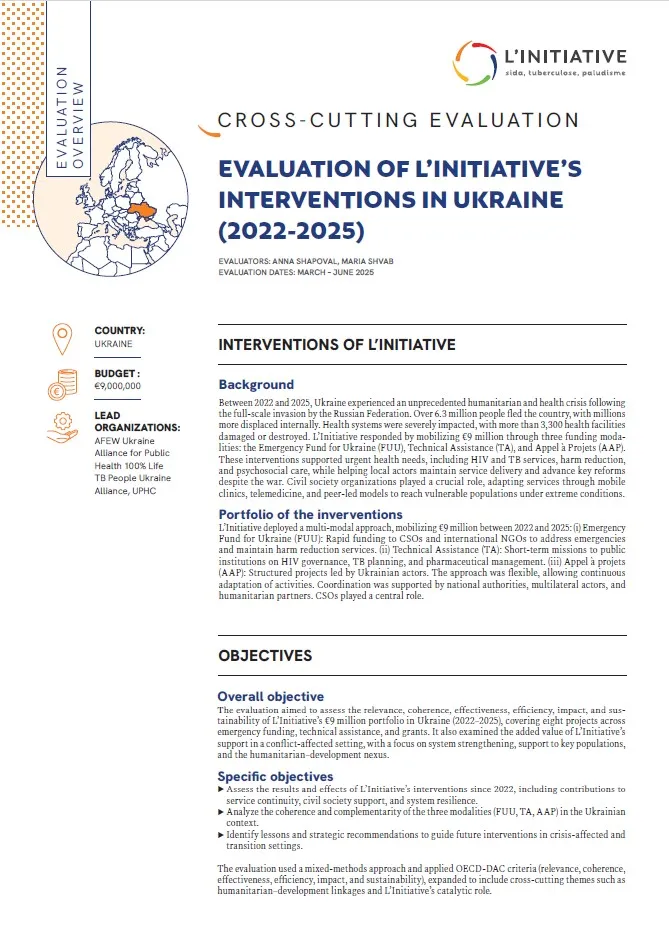
Cross-cutting Evaluation – L’Initiative’s Interventions in Ukraine (2022–2025)
Four years after the start of the full-scale invasion, this independent evaluation analyses the interventions supported by L’Initiative in Ukraine since 2022. It highlights the conditions under which health actions have been implemented in a context of prolonged war, the results achieved in terms of continuity of care, and the limitations encountered with regard to institutional anchoring and sustainability.