
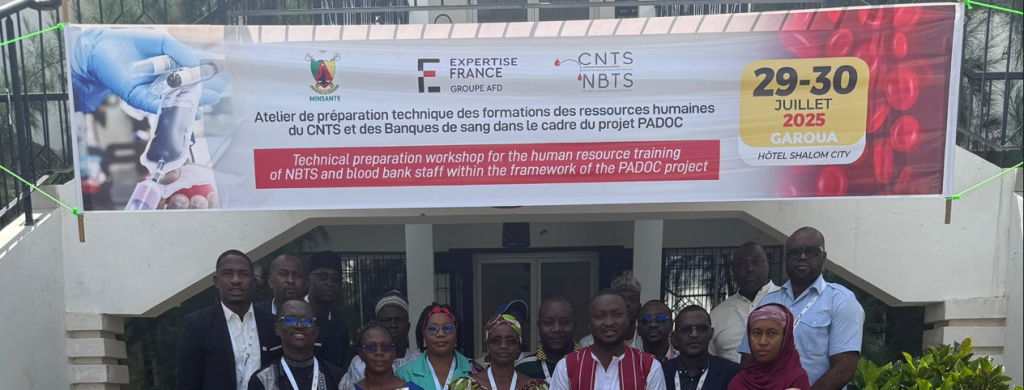
To support the operational rollout of the National Blood Transfusion Centre, the PADOC project aims to ensure the availability of safe, high-quality blood products by training actors across the transfusion chain and mobilising communities for voluntary, non-remunerated blood donation.
Context
To strengthen Cameroon’s blood-transfusion system, this project builds on previous support from the Agence Française de Développement and Expertise France, which included funding, a situational analysis and the development of a national roadmap. Based at the CNTS — the sole operator responsible for national transfusion policy — PADOC aims to fill gaps not covered by other partners, notably in human-resources training and community mobilisation for voluntary, unpaid blood donation. Complementing infrastructure funded by the Islamic Development Bank, this project represents a major lever to improve management of life-threatening emergencies (obstetric emergencies, severe malaria, HIV, tuberculosis, haemodialysis, accidents) and to guarantee access to safe, quality blood products.
Description
The PADOC project seeks to increase the availability and quality of safe blood products in Cameroon. Its first 12-month phase focuses on strengthening technical human resources, training 50 staff from the CNTS and Hospital Blood Banks (BSH) across six regions (Centre, South, East, Far North, North, Adamawa). Implemented in partnership with Safe Blood for Africa and with technical support from EFS, the project will develop contextualised training modules, establish a national transfusion-data management system and promote best transfusion practices. Phase 2, also lasting 12 months, will concentrate on capacity-building and collaboration with civil-society actors to improve public awareness, community mobilisation and voluntary blood-donation drives.
Impact
The project aims to:
- Securely and sustainably strengthen Cameroon’s blood-collection system through staff training and partner capacity-building;
- Improve the quality of transfusion services;
- Establish long-term sustainable practices as standard practice;
- Pilot innovative approaches to blood collection;
- Reduce the risk of transfusion-transmissible infections;
- Develop a comprehensive transfusion database.