

The HIV response in Madagascar
In Madagascar, faced with an officially estimated HIV prevalence of 0.5% that is likely underestimated, L’Initiative is stepping up its support for the HIV response. Two stakeholders share their perspectives: Christophe Vanhecke, Regional Adviser for Global Health (Indian Ocean), and Kablan Prao Raimond, a resident HIV expert supported by L’Initiative.
HIV in Madagascar: what is the epidemiological situation?
Christophe Vanhecke: The last national survey dates from 2009 and placed prevalence at 0.5% via the UNAIDS Spectrum model. At present, the HIV epidemic profile in Madagascar remains concentrated among key populations — men who have sex with men (18%), people who use drugs (13%) and sex workers (11%).
However, recent regional studies raise fears of a spillover into the general population — up to 3% in some areas — and prevalence as high as 10–13% along major transport corridors. The situation is alarming: according to UNAIDS (2023), it is estimated that only 23% of the 76,000 people living with HIV (PLHIV) know their status and only 22% would be on antiretroviral therapy (ART). This underlines the importance of carrying out an HIV and syphilis seroprevalence survey, co-funded by L’Initiative, the World Health Organization, UNICEF and the Global Fund, to obtain up-to-date data and steer the response effectively.
Kablan Prao Raimond: Those figures directly guide our priorities: increase testing, bring services closer to people and reduce treatment interruptions. If the survey tomorrow confirms a wider spread, the National Strategic Plan for HIV will need to be adapted to reach the general population while maintaining focus on key populations. According to the 2022 Biological and Behavioural Surveillance Survey (BBSS-2022) among key populations living with HIV, only 27.6% of men who have sex with men, 20% of people who use drugs and 17.9% of sex workers knew their serological status.
How does task-shifting strengthen the HIV service offering?
Kablan Prao Raimond: I arrived in January 2025 with support from L’Initiative; my role is to assist the country in implementing a task-shifting strategy for HIV service delivery in view of human-resource challenges in the health sector and the difficulty of meeting HIV response targets.
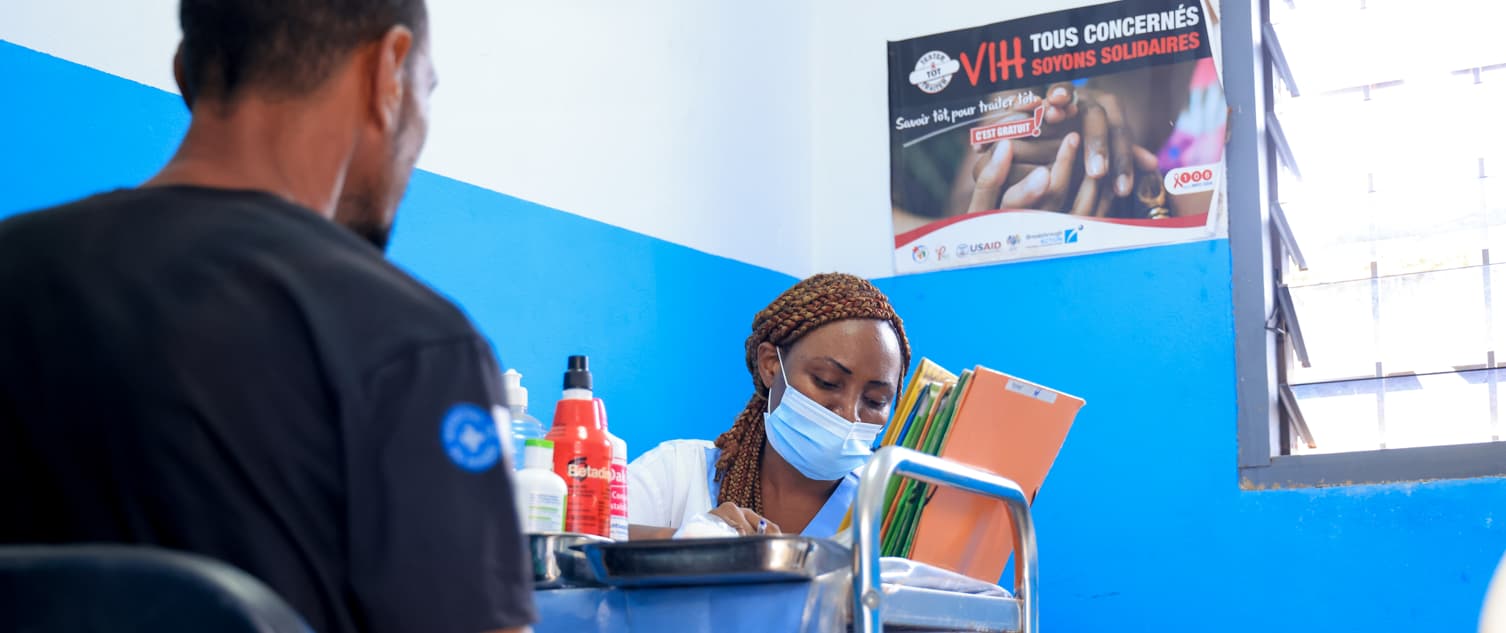
Task-shifting in the HIV response covers several pillars, such as delegating testing and follow-up tasks to nurses, peer educators or community health workers to compensate for the acute shortage of physicians. We aim to decentralise services down to level-I health centres, optimise the 95-95-95 targets (at least 95% of PLHIV know their HIV status; at least 95% of those who know their status are on ART; at least 95% of those on treatment are virally suppressed) and guarantee access to HIV services for marginalised populations.
For example, at Primary Health Centre No. 2 in Ambilobé, paramedical staff now perform HIV testing and initiate ART — a practice we recommend for national scale-up.
What role does L’Initiative play in the HIV response?
Christophe Vanhecke: L’Initiative acts as a catalyst in the HIV fight. Its interventions rest on a dual logic: community proximity (organisation, peer educators, community health workers) and capacity-building, notably at institutional and organisational levels (training, advocacy, coordination).
Its action complements interventions by Gavi and the Global Fund: funding catalytic, innovative projects, supporting the seroprevalence survey, strengthening the National HIV Control Programme, providing technical assistance to the Ministry of Health, and animating the so-called “France triptych” (the Embassy, the Agence Française de Développement and Expertise France) for bilateral and multilateral coordination. It also ensures alignment of HIV projects with tuberculosis, malaria, sexual and reproductive health and rights, and cervical cancer projects — for a comprehensive response.
What major challenges remain?
Kablan Prao Raimond: The shortage of qualified health personnel in sufficient numbers and the dilapidated state of infrastructure hamper service provision. Task-shifting is one element of the response, but institutional commitment and coordination must also be reinforced, additional resources mobilised for implementation and scale-up, and service quality ensured.
Christophe Vanhecke: Despite government efforts to strengthen the health system, the Malagasy population remains insufficiently protected against health threats. The main challenges may lie in establishing effective Universal Health Coverage for equitable access to quality care, improving child vaccination coverage, and strengthening infrastructure and human resources for health. The State budget for health is insufficient given the needs.
What are your perspectives or hopes for the HIV response in Madagascar?
Kablan Prao Raimond: In the coming years I hope to see the operational plan for task-shifting implemented. Task-shifting will serve as a springboard toward an inclusive model in which every actor — health centres, community NGOs, peer educators — strengthened in capacity contributes to the 95-95-95 objective.
Christophe Vanhecke: To fight HIV effectively, activities must focus on awareness-raising and early testing, particularly among young people (pregnant women, secondary- and tertiary-level students). The future depends on training health professionals and reinforcing regional coordination: Comoros, Madagascar, Mauritius and Réunion must share know-how, testing technologies and lessons learned. Through L’Initiative and, more broadly, French support, the benefits of this strategy are already being felt.