
supported
SOFIA – Strengthening Civil Society Organisations
Through its SOFIA mechanism – Structuring Civil Society Organisations: Financing, Impact and Support – L’Initiative supports the scale-up of local civil society organisations (CSOs) engaged in the fight against HIV, tuberculosis, and malaria. Launched in 2023, SOFIA combines financial support, tailored technical assistance, and organisational strengthening. It aims to durably consolidate community-rooted CSOs, enabling them to lead more structured interventions, access new funding streams, and more effectively amplify the voices of the populations they serve.

19 CSOs

8 countries
of implementation

Since 2023
an ongoing commitment
Tailored Financial and Technical Support
The 19 CSOs currently supported by SOFIA were selected through two calls for expressions of interest published in 2023 and 2024, across eight countries: Benin, Djibouti, Gabon, Guinea, the Central African Republic, the Republic of Congo, Chad, and Togo.
Before support begins, each organization undergoes an initial assessment to identify its institutional, organizational, programmatic, and technical needs. This assessment leads to a capacity-strengthening plan designed with a multi-year logic.
Support to CSOs combines two complementary modalities:
Financial support
through a grant of between €50,000 and €75,000 over a 15-month. This grant can cover operating costs, human resources, or activities. It enables organizations to stabilize their work, strengthen their teams, and secure the resources needed to carry out their projects.
Personalized technical assistance
provided throughout the implementation of the grant. This support draws in particular on national consultants and field professionals, in order to provide responses tailored to the needs of local or intermediary organizations.
This support covers institutional dimensions (governance, strategic partnerships, advocacy), programmatic dimensions (quality of activities, beneficiary reception and follow-up), and organizational dimensions (financial management, methods, procedures, and internal tools).
Supporting CSOs to Strengthen Health Systems
The aim of the mechanism is to support local CSOs in order to foster their active participation in the fight against pandemics, the strengthening of health systems — including community-based ones — and the promotion of human rights and gender equality. By strengthening their internal structures, SOFIA enables supported organizations to gain in autonomy, credibility, and capacity for action. The mechanism aims in particular to enable them to:
- Access larger and more diversified funding from national, regional, and international partners;
- Manage their activities more effectively and sustainably;
- Strengthen their advocacy capacities;
- Carry greater weight in national public health debates;
- More powerfully amplify the voice of the communities they represent or support.
19 CSOs Supported Across 8 Countries
SOFIA operates in contexts where civil society organizations have limited opportunities for funding, capacity-building, or technical support. The mechanism supports mid-sized organizations capable of driving lasting change, engaged in the fight against HIV, tuberculosis, and malaria, and working to strengthen health systems and improve access to health for key populations — including in the area of sexual and reproductive health and rights.
The mechanism currently supports 19 CSOs across 8 countries of implementation: Benin, Djibouti, Gabon, Guinea, the Central African Republic, the Republic of Congo, Chad, and Togo.
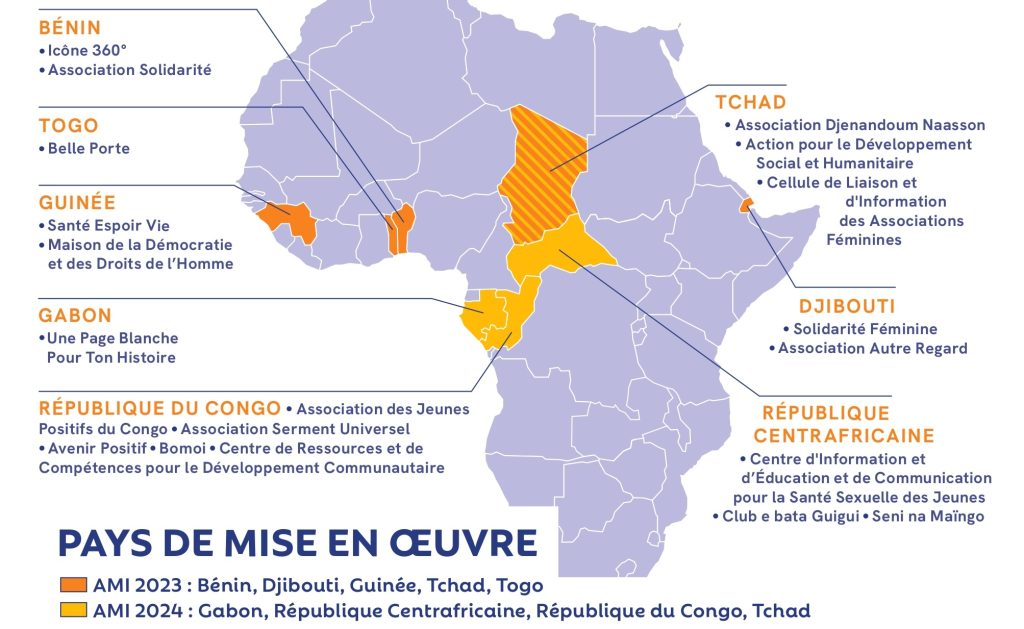
These organizations work across complementary areas: awareness-raising, prevention, access to care, psychosocial support, community health, rights advocacy, combating discrimination, and support for vulnerable or marginalized populations.
Their diversity reflects one of the mechanism’s core principles: supporting organizations already rooted in local realities, but which need resources, tools, and accompaniment to scale up and strengthen their contribution to national responses.
Concrete Impacts Already Visible at Community Level
Beyond the activities carried out with communities, SOFIA above all produces structural changes within supported organizations. By covering operating costs, human resources, and support functions, the mechanism enables CSOs to consolidate their organization, and free up time and resources to develop partnerships and seek new funding.
Several supported CSOs have put in place management tools they had not yet formalized: computerized accounting systems, procedure manuals, multi-year strategic plans, and monitoring and evaluation tools. Some have been able to recruit or consolidate key profiles: coordination, monitoring and evaluation, and administrative and financial management. Others have clarified their internal roles, renewed their governance bodies, or secured team continuity through more regular remuneration.
These developments strengthen their credibility with technical and financial partners, their capacity to report on their activities, to respond to new funding opportunities, and to play a greater role in their national ecosystem.
Better structured, better equipped, and better supported, CSOs are also able to go further in their work with communities:
- In Benin, Association Solidarité has established a vital emergency fund to finance hospital care, support difficult pregnancies, and assist people following an assault — including psychological and legal support.
- In Djibouti, Autre Regard has launched medical and psychological consultations on its premises — a service that did not exist before SOFIA’s support.
- In Guinea, Santé Espoir Vie has developed community-based antiretroviral dispensing, bringing treatments closer to people living with HIV who are furthest from the health system.
- In Chad, Djenandoum Naasson has introduced differentiated care: each group of patients elects a representative responsible for collecting treatments each month, helping to reduce gaps in follow-up.
Other organizations are strengthening their advocacy work:
- In Benin, Icône 360° is working toward better coordination of CSOs at the national level.
- In Guinea, the Maison de la Démocratie et des Droits de l’Homme has been able to mobilize new funding to expand its programs.
The 19 CSOs Supported by SOFIA

Action pour le Développement Social et Humanitaire
Based in N’Djamena and active in several provinces across the country, ADESOH works for vulnerable populations, focusing its action on five areas: access to safe drinking water, health and nutrition, resilience to climate, economic and social crises, social rights, and education.

Association des Jeunes Positifs du Congo
AJPC works to prevent HIV/AIDS and improve the well-being of people infected and/or affected by the virus. It works to decentralize prevention activities, expand access to antiretroviral treatment, and defend the rights of people living with HIV, with particular attention to young people, adolescents, and children orphaned by AIDS, whom it supports both psychologically and in accessing care.
Association Djenandoum Naasson
Active in Moundou, Chad, the association works to ensure access to care for key populations in this area of high HIV prevalence. It runs a testing and comprehensive care center that supports more than 2,000 patients living with HIV, tuberculosis, and malaria.
Association Serment Universel
The association is engaged in HIV prevention, screening, and psychosocial support for affected individuals and their families, drawing on awareness and training programs in service of community development.

Association Solidarité
The Beninese association provides sex workers with comprehensive support: HIV and STI screening, medical care, psychosocial and legal support, and the defense of their rights.

Autre Regard
In Djibouti, the association fights against HIV, STIs, and precarity, particularly among people living with HIV and vulnerable women. Together with national authorities and the Global Fund, it deploys peer educators for prevention, screening, and psychosocial support.
Avenir Positif
In the Republic of Congo, Avenir Positif works to improve the quality of life of children, adolescents, and young people living with HIV, through screening, medical, social, and psychological care, and the fight against stigma

Belle Porte
The NGO advocates for people with disabilities and works to ensure they can fully exercise their rights to health, education, and employment. It also has a malaria and tuberculosis unit, active in Moyen Mono, Togo.
Bomoi
In the Republic of Congo, Bomoi works to reduce deaths linked to blood shortages by promoting voluntary blood donation. The association combines community awareness and mobilization campaigns, strengthening of local health facilities, and development of a digital blood management platform.
Cellule de Liaison et d’Information des Associations Féminines
A national network of Chadian civil society, its mission is to defend women’s rights and strengthen their participation in development. Through advocacy, awareness-raising, and networking, it works for equality and equity, while supporting the capacities of its affiliated organizations.

Centre d’Information et d’Éducation et de Communication pour la Santé Sexuelle des Jeunes
Founded in 1994, this Central African NGO specializes in youth sexual and reproductive health. It offers integrated services in HIV and STI prevention, screening, and care, family planning, and comprehensive sexuality education, while providing psychosocial support for young people and community-based ARV dispensing.
Centre de Ressources et de Compétences pour le Développement Communautaire
In the Republic of Congo, CERCODE places community health at the heart of its work with the most vulnerable populations. The association is active in the fight against HIV, tuberculosis, malaria, and STIs, as well as sexual and reproductive health, psychosocial support, and educational support for adolescents.
Club E Bata Guigui
Founded in 2018 at the initiative of UNICEF and CHUPB, Club E Bata Guigui is a community-based association dedicated to children, adolescents, and young people living with HIV. It helps keep them engaged in the continuum of care through psychosocial support, therapeutic education, and peer support, while also contributing to the fight against stigma, tracing patients lost to follow-up, and strengthening access to care.
Icône 360°
Committed since 2016 to the fight against malaria in Benin, the NGO leads prevention and awareness campaigns among young people, women, and decision-makers to change health-related behaviors.

Maison de la Démocratie et des Droits de l’Homme
In Guinea, M2DH mobilizes young people to make them agents of their own health and rights. Through school-based awareness sessions and community workshops, the organization works on violence prevention, access to sexual and reproductive health, and the fight against malaria.
Santé Espoir Vie
The NGO operates throughout Guinea to prevent and manage HIV, tuberculosis, malaria, and Ebola. It provides comprehensive support to the communities most vulnerable to epidemics, including through a community-based antiretroviral treatment dispensing system and support to 15 health centers to strengthen prevention of mother-to-child HIV transmission.
Séni na Maïngo
Founded in 2019, SENI NA MAÏNGO (SNM) is an organization specializing in community monitoring, advocacy, and health governance. It works in the fight against HIV, tuberculosis, and malaria, and runs a community-based healthcare access observatory responsible for documenting service disruptions, barriers to care, and user satisfaction to inform dialogue with health authorities.
Solidarité Féminine
The association supports people living with HIV and their children to protect their health and dignity, particularly through nutritional support and psychosocial care.

Une Page Blanche Pour Ton Histoire
In Gabon, the association works on prevention, screening, and care for HIV and STIs among the populations most at risk — young people, LGBTQ+ communities, incarcerated individuals, and sex workers — while combating stigma and discrimination.