
Strengthening National Implementation and Management of International Funding in the Sahel
In Chad and Mauritania, the technical assistance facility (TAF), supported by The Initiative, is helping drive a profound transformation of national health systems – enabling health ministries to directly manage Global Fund financing. In 2025, the two facilities were merged to form a single Sahel TAF, pooling expertise and enhancing the effectiveness of the support provided. Mohamed Coulibaly, an HIV expert at the Sahel TAF, and Dr. Théo Kusiaku, the facility’s lead expert, reflect on tangible progress, the impact of this merger, and the challenges that remain.
To start, could you briefly explain what the Sahel Technical Assistance Facility does?
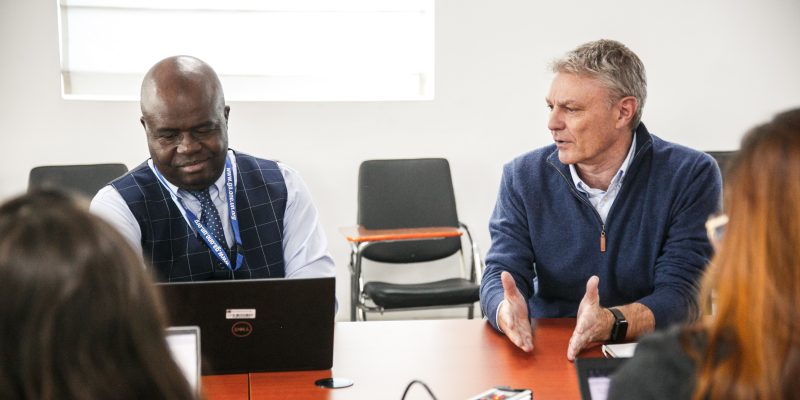
Mohamed COULIBALY: The technical assistance facility is a long-term support mechanism, co-designed with the Mauritanian and Chadian authorities, aimed at helping countries make better use of Global Fund financing. In practice, we work on a daily basis with health ministries, management units, programs, and civil society organizations to improve grant implementation and strengthen its impact on the ground. It is a highly operational form of accompaniment, deeply embedded in the work of national teams, with the goal of improving countries’ performance in implementing Global Fund grants.
Théo KUSIAKU: In Chad, this facility was established in response to a request from the Ministry of Health, which sought to reclaim direct management of financing that had previously been entrusted to external actors. Our role is to support this transition – structuring teams, putting tools in place, building capacity, and progressively enabling the Ministry to manage grants effectively and sustainably on its own.
Before the TAF was established, what were the main challenges?
Mohamed COULIBALY: In Mauritania, the situation was particularly fragile. Programs had been weakened, with very few qualified staff and overall performance falling short of expectations. Grant management faced numerous difficulties, particularly in planning, implementation, monitoring, and coordination. We had to both build team capacity and intervene directly to restart activities.
Théo KUSIAKU: In Chad, financing was largely managed outside the Ministry. No solid structure existed to handle it internally. The first priority was therefore to establish a management unit within the Ministry, and then to progressively build its capacity to take over the full range of grants.
What has the facility concretely changed today?
Théo KUSIAKU: Today, Chad’s Ministry of Health has taken over the vast majority of grant management, with a structured and fully functional management unit. This shift has strengthened the Ministry’s credibility with partners and has helped attract new financing. It sends a strong signal: the Ministry is now recognized as an actor capable of managing these resources. The Ministry of Health’s Project Management Unit now oversees financing from the Global Fund, but also from Gavi, the Bill & Melinda Gates Foundation, and Expertise France — including a project to strengthen human resources for health.
Mohamed COULIBALY: In Mauritania, the results are visible on several levels. The national programs for HIV, tuberculosis, and malaria, along with Ministry directorates and civil society organizations, have made progress in implementing activities under the Global Fund’s GC7 grant. With the support of the Sahel TAF, joint planning brought stakeholders together and led to the development of the technical documents needed for implementation.
On HIV, for example, the TAF contributed to operationalizing PMTCT (Prevention of Mother-to-Child Transmission) and is supporting a project targeting the triple elimination of mother-to-child transmission of HIV, syphilis, and hepatitis B. There has also been a marked improvement in patient follow-up and data quality. We went from a handful of early diagnosis cases to several dozen within a year. Beyond the numbers, it is the health system’s capacity to produce, analyze, and use data that has fundamentally changed — and that has a direct impact on program performance.
Why was the decision made to merge the Chad and Mauritania facilities?
Théo KUSIAKU: The two facilities were complementary. In Chad, we had developed expertise in the cross-cutting functions of grant management – governance, finance, monitoring and evaluation, supply chain management. In Mauritania, teams were more focused on disease program implementation. Merging the two allows us to combine these approaches and provide far more comprehensive support to both countries, at a time when Mauritania’s Ministry of Health is also set to become the principal recipient of Global Fund grants from 2026 onward.
Mohamed COULIBALY: For us in Mauritania, this development was decisive. We were disease experts, but we also had to cover complex cross-cutting functions. The merger now allows us to draw on a complete team, with the skills needed to structure both the management and implementation of grants.
In practice, what has changed in your day-to-day work?
Théo KUSIAKU: We recently organized a joint monitoring and evaluation training, bringing together teams from both countries. This training helped harmonize practices and improve the quality of data work. The effects were quickly visible — particularly in Mauritania, with better-prepared reports for the Global Fund. We now work with both shared activities and missions specific to each management unit.
Mohamed COULIBALY: It has had a very tangible impact. Previously, we faced significant traceability challenges: some information was not being properly collected or consolidated. Today, teams are able to better document activities and results. This changes the relationship with partners, because we can now demonstrate what is being done. Beyond that, capacity strengthening of national actors continues on a daily basis – both through routine activity implementation and through dedicated workshops led by Sahel TAF experts.
How does the facility fit within the broader landscape of projects deployed in both countries?
Mohamed COULIBALY : In Mauritania, we work in close coordination with several projects, including civil society organizations and initiatives such as the ZeroVIH project implemented by Expertise France. These dynamics enable targeted implementation on the ground, while the TAF provides a technical framework, builds capacity, and strengthens results monitoring. The two approaches are mutually reinforcing.
Théo KUSIAKU : In Chad, the TAF is deeply integrated into the ecosystem of projects led by Expertise France and, more broadly, by the French team. It plays a structuring role by contributing to the coherence and quality of interventions – particularly through the strengthening of Ministry structures.
What are the main challenges today?
Théo KUSIAKU : The main challenge remains the turnover of national staff supported by the TAF. The teams we train quickly become highly sought-after and may be recruited elsewhere. This means capacity-building work often has to start over, which can slow the consolidation of progress made.
Mohamed COULIBALY : In Mauritania, human resources are also a central issue. It is essential to have profiles that match the demands of the roles. Capacity building can only go so far if the foundations are not strong enough. There is therefore a challenge around recruitment, but also around building teams that are durably structured.
What would success look like for you over the next two to three years?
Mohamed COULIBALY : Success would mean a system capable of managing grants with strong performance – and sustaining those results over time. Today, we are aiming for improved ratings, but above all for lasting stability in results, which remains a major challenge.
Théo KUSIAKU : I would say success would be a fully operational management unit, with autonomous teams, clear governance, and smooth processes. The goal is for the system to function sustainably, with technical support that is gradually scaled back.
One final thought to close?
Mohamed COULIBALY : The question of the facility’s continuity is central. On the ground, stakeholders regularly ask us about the future of the TAF. There is strong demand, but also real uncertainty. The system is progressing, but it remains quite dependent on this support.
Théo KUSIAKU : Yes, the future of the Sahel TAF is a key issue for the health ministry authorities in both countries, and for the Global Fund’s country teams as well. The goal remains to support the transition without disruption. We need to consolidate what has been achieved and gradually scale back our support so that these gains can be sustained over the long term.