
In Côte d’Ivoire, harm reduction takes root in the public health system
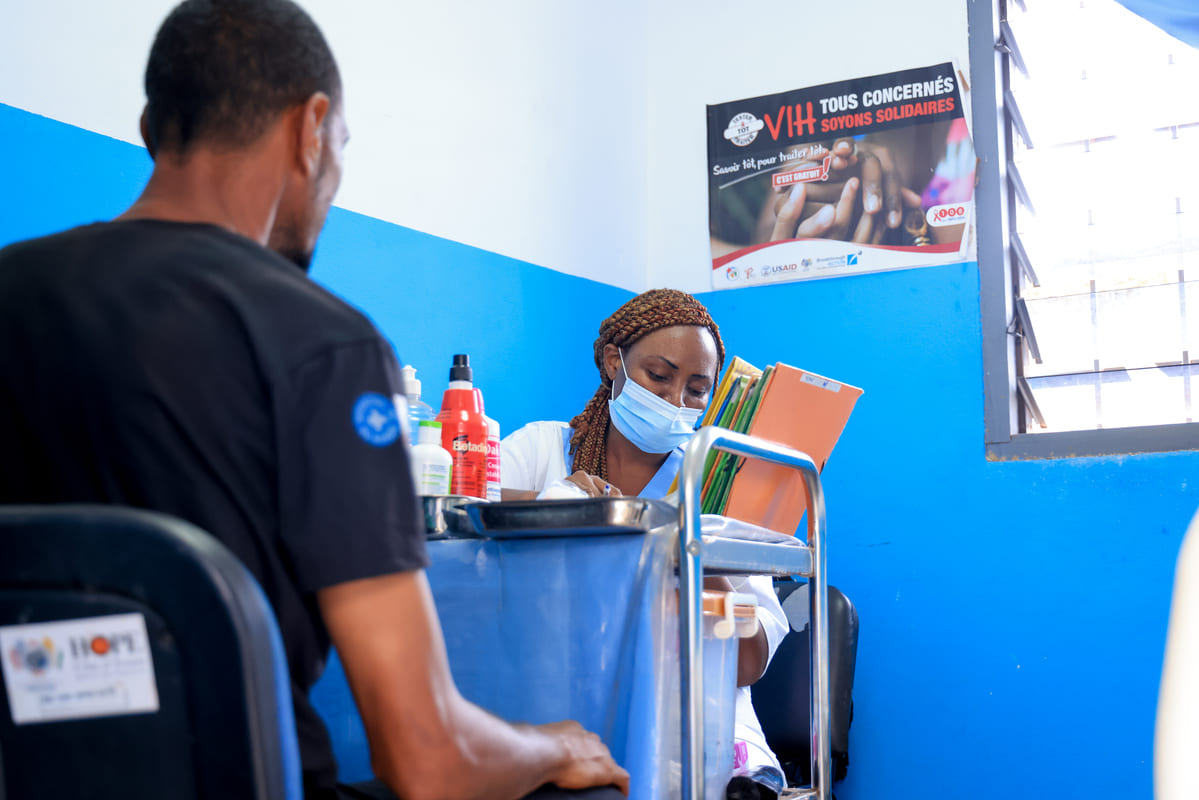
Supported by L’Initiative, the YA FOHI project is strengthening a care offer tailored to people who use drugs in Côte d’Ivoire — a population at particularly high risk of HIV and tuberculosis. Implemented by the NGO Espace Confiance and its partners, it builds on work begun in 2015 with Médecins du Monde. The project consolidates an integrated care model combining harm reduction, community support, methadone, mental health, social assistance, and rights-based advocacy. Dr Camille Anoma, Director of Espace Confiance, and Dr Patricia Zougouri, Head of Programmes, reflect on the relocation of the Addictions Care and Support Centre (CASA) to the General Hospital of Port-Bouët — an important step toward embedding harm reduction durably within the public health system, without breaking the trust built with the people the project serves.
What is the YA FOHI project now making it possible to consolidate?
Dr Patricia ZOUGOURI: YA FOHI follows on from a project dedicated to people who use drugs, which aimed to implement harm reduction at both the community and clinical levels. Espace Confiance, together with APROSAM, ENDA Santé, and ASAPSU, took over to ensure local ownership of this offer and guarantee continuity of services.
Today, care is provided across four centres: the two Addictions Care and Support Centres (CASA) in Abidjan and San Pedro, and two further centres in Bouaké and Abidjan. After more than two years of implementation, the results are encouraging. More than 3,000 people who use drugs have been reached through this holistic service offer. On methadone, we have gone from around ten or twenty people supported at the start of the project to more than 100 today.
The project has also strengthened advocacy around the new drug use law. We have worked with actors across the judicial chain to raise awareness of this law and support its application on the ground. One of its key provisions is therapeutic injunction: rather than sending people who use drugs directly to prison when arrested, it allows for their referral to a care pathway. In Abidjan, around twenty people have already been referred to us under this framework by prosecutors.
Why is the relocation of the Abidjan CASA to the General Hospital of Port-Bouët such an important step?
Dr Camille Anoma: One of the project’s major objectives, supported by Expertise France, was to ensure the sustainability of what had been built at the Abidjan CASA. Until now, project funding covered rental costs as well as water and electricity bills. There was therefore a real risk to service continuity once the project ended.
Since March, the teams have been based at the General Hospital of Port-Bouët and all activities have been integrated there. For us, this is a model worth building on. In a context of declining international funding, the challenge is now to find ways to similarly sustain the other activities carried out with highly vulnerable and key populations.
We are also in discussions with the Ministry to explore how to maintain a relevant, holistic technical platform within a public facility — and to move toward a centre of excellence for the care of highly vulnerable populations.
What does this integration into a public hospital change for people who use drugs?
Dr Camille ANOMA: The CASA remains a centre dedicated to people who use drugs. We have our own space, our own building, and we have transferred all activities from the former CASA to the new one. The advantage is now being inside a hospital: for conditions we cannot manage directly, referral is much simpler — the relevant specialist service is right next door.
The former CASA was located close to a large smoking site. The new site is a little further from some drug use locations, though it is closer to others. It will therefore take time for the people concerned to find their way to this new place. That said, we have already seen that the active caseload of people on methadone has not been affected by the move.
Dr Patricia ZOUGOURI: Previously, for a person who uses drugs, walking into a public facility could be very difficult. The relocation of the CASA to the General Hospital helps break down those barriers. It creates a new reflex: a public health centre is also a centre for them.
We also organised an activity with the hospital’s midwives, who had some apprehensions about working with women who use drugs. When they were brought together, it went very well. There is a kind of reconciliation taking place — between people who use drugs, health facilities, and the providers who work in them.
How do you maintain the trust built with the people you serve?
Dr Patricia ZOUGOURI: We are still in a transition phase. Some of the people we were reaching at smoking sites may not yet have heard about the relocation. This is where peer educators play an essential role — though their numbers remain insufficient.
They are able to reach people who use drugs directly in the places where they live and use, explain the relocation, and guide them toward the new CASA. Their presence is indispensable to preventing a sharp break in the care pathway.
Dr Camille ANOMA: This trust exists because we are not new to this issue. The work began in 2015, across three phases supported by Expertise France. In 2018, the creation of the CASA made it possible to offer specific services — but also a form of dignity: being able to take a shower, wash clothes, be accompanied and cared for.
This trust is sustained through community work, including by people who use drugs themselves, mobilised as peer educators.
You speak of integrated care. What does this approach actually involve?
Dr Patricia ZOUGOURI: At Espace Confiance, including at the CASA, the approach is genuinely integrated. There is first the community dimension, through peer educators. Then there is the clinical component, with trained providers: addiction specialists, general practitioners, psychologists, and psychiatrists. The support covers HIV, tuberculosis, malaria, primary healthcare, and first-level mental health.
Alongside this, there is also a social, professional, and legal dimension. Paralegals are present at sites to identify cases of violence and support individuals. We also work on professional integration, economic support, training, and social reintegration.
Dr Camille ANOMA: We also organise family lunches, to which the families of people who use drugs are invited. Many have been excluded from their families, which makes family mediation particularly important. There is also the full range of administrative support: many people have no identity documents. We accompany them to the tribunal to obtain a birth certificate, and then a national identity card.
Methadone, an opioid substitution treatment, is a key lever — but scaling it up remains difficult. What are the main obstacles?
Dr Patricia ZOUGOURI: One of the main challenges is product availability. These are technical coordination issues between programmes — not necessarily funding problems. There is also a need for suppliers capable of providing the country with a reliable, regular supply.
Then there is the logistics. For a long time, people on methadone had to come to the centre every day. This was difficult for them, and difficult for providers too. Things are beginning to change with take-home doses, but these issues have held back the expansion of the offer.
There is also a connection with therapeutic injunction. Thanks to the advocacy carried out, judicial actors are now referring people who use drugs to us. But this requires having the capacity to support them. Without sufficient methadone, it also limits this progress.
Dr Camille ANOMA: There is genuine political will within the National Programme for the Fight against Tobacco Use and Addiction to make methadone more widely available. But this will require logistical investment. The goal must be to go to people — with mobile teams — rather than always asking them to come to the centre.
What needs remain insufficiently addressed for women who use drugs?
Dr Patricia ZOUGOURI:Women who use drugs face multiple, overlapping vulnerabilities. They are women, they use drugs, some are also living with HIV, and they are exposed to violence. The specific services they need are not always available.
We have tried to develop dedicated activities, but with shrinking budgets, this is difficult. On methadone, they are among the priority groups. We have also created spaces where they can speak about violence and gender-based inequalities.
But it is not enough. Some women find themselves with their children in smoking sites. Emergency housing needs to be strengthened, as does pregnancy follow-up, access to sexual and reproductive health services, and menstrual hygiene — and concrete responses to violence need to be developed.
Dr Camille ANOMA : Many women who use drugs also engage in sex work to fund their drug use. There are avenues to explore, particularly around financial empowerment, training, and skills development. But without sufficient financial resources, it will be very difficult to respond to the scale of the need.
Under what conditions can this model become sustainable within the Ivorian health system?
Dr Patricia ZOUGOURI : One of the key factors is state involvement. The National Programme for the Fight against Tobacco Use and Addiction has taken ownership of the issue, and this has facilitated the relocation process. On the legal front, we have also worked with the Inter-ministerial Anti-Drug Committee, which has allowed us to reach prosecutors and the Ministry of Justice.
We have also conducted awareness-raising caravans in police stations, alongside law enforcement officers and Phoenix — our community group of people who use drugs. The goal is for an arrest not to lead automatically to prison, but to also open a pathway toward referral to a CASA centre. This collaboration between the state and civil society is essential. If we do not start working with those who will need to ensure sustainability, it becomes very complicated.
Dr Camille ANOMA : The advocacy conducted around the new law has made it possible to build an offer that can be sustained. But much work remains. In a context of declining international funding, it is essential to preserve support for civil society — in particular to continue advocacy for harm reduction, the enforcement of the law, and effective access to care.