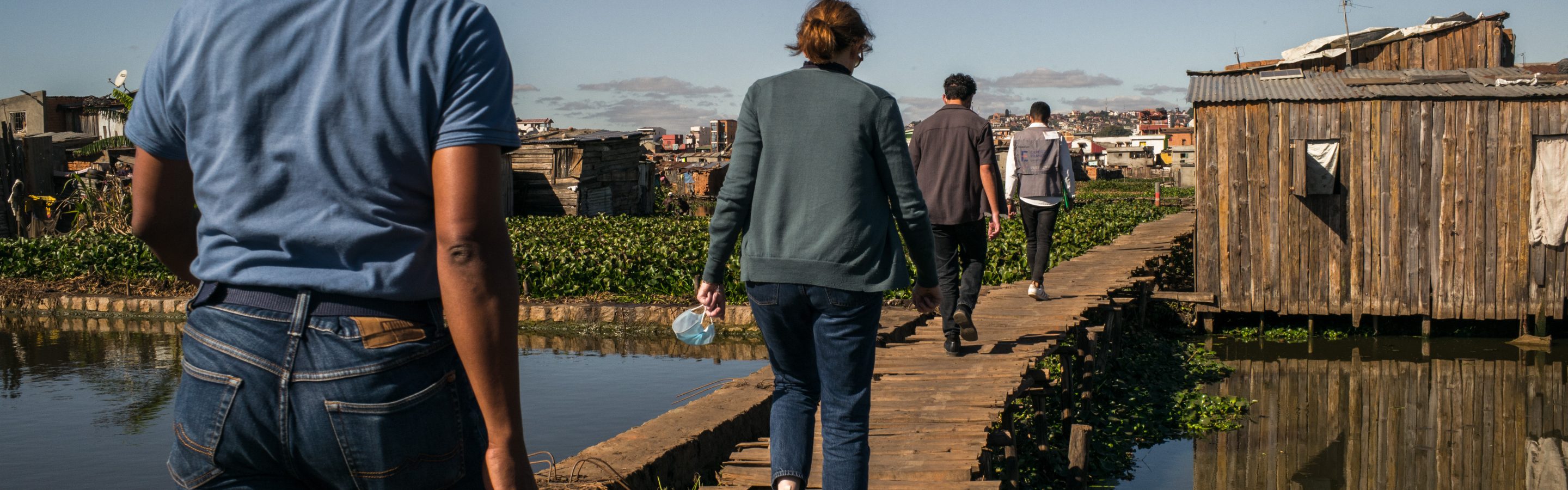
Madagascar: new data to better target the response
After fifteen years without a robust national survey, Madagascar now has essential new data to inform its HIV response. Rébecca Gillard, Regional Manager for Eastern and Southern Africa, the Indian Ocean and the Caribbean at L’Initiative, discusses two studies conducted in Madagascar. One measures the prevalence of HIV and syphilis among more than 22,000 pregnant women, while the other examines the prevention of mother-to-child transmission.
Why had it become necessary to update HIV data in Madagascar?
Rébecca Gillard: The last robust national surveys dated back to 2009. Since then, estimates had relied primarily on modelling, which put HIV prevalence at around 0.4%. However, several frontline stakeholders had raised concerns that the scale of the epidemic might be underestimated. New data were needed to determine whether the epidemic remained concentrated among key populations or was spreading more widely. This information was intended to help the authorities adapt prevention, testing and care services, and guide resource allocation.
What studies were conducted to better understand the epidemic and the health system’s response?
Rébecca Gillard: Two complementary studies were conducted.
The National Seroprevalence Survey (ENS, its French acronym) aimed to measure the prevalence of HIV and syphilis among pregnant women across the country’s 23 regions, examining disparities by age and place of residence. As a general population survey was deemed too ambitious and costly, we focused on more than 22,000 women attending their first antenatal care visit at 228 health facilities. The methodology was based on an anonymous approach combining interviews, the collection of sociodemographic and medical data, and testing.
In parallel, the situational analysis of the triple elimination of mother-to-child transmission of HIV, syphilis and hepatitis B aimed to identify barriers to prevention and care throughout the care pathway.
What do the preliminary findings reveal?
Rébecca Gillard: The findings should be interpreted with caution, given the data collection conditions and the challenges encountered. Nevertheless, they appear to confirm that the epidemic is spreading beyond key populations. Among women attending antenatal care, the test positivity rate was estimated at 1.1% for HIV and 1.7% for active syphilis. One finding is particularly striking: in a region in the north of the island, the HIV test positivity rate reached 7.8%.
As the survey was conducted among a specific sample, its findings cannot be extrapolated to Madagascar’s entire population. They do, however, highlight the need for strategies tailored to regional realities.
What did the triple elimination analysis achieve?
Rébecca Gillard: It provided an assessment, developed jointly with national stakeholders, of existing measures to prevent mother-to-child transmission of the three infections. The assignment, conducted from September 2025 to July, combined a document review, interviews with institutional stakeholders, community consultations and field visits. It resulted in a costed operational plan for 2027–2028 tailored to district-level needs, as well as monitoring and training tools.
How are these studies informing national priorities?
Rébecca Gillard: They contributed to the National Strategic Plan for the Prevention and Control of Sexually Transmitted Infections and AIDS for 2027–2030 and to the preparation of the funding request for the Global Fund’s eighth grant cycle (GC8). They provide evidence to help refine geographical priorities. In particular, the funding request includes plans to strengthen integrated HIV and syphilis testing among pregnant women and expand campaigns in the most affected districts. The triple elimination analysis also informed discussions on a pilot project addressing hepatitis B.
L’Initiative’s technical support has thus helped generate new knowledge and translate it into strategic decisions and targeted interventions.
Do the new data mean that national priorities need to shift?
Rébecca Gillard: It is not about shifting priorities, but rather refining them. The epidemic remains heavily concentrated among key populations, who must remain at the heart of the response. Interventions targeting these populations must be maintained, while prevention and testing efforts need to be strengthened in areas where new epidemiological trends are emerging, particularly in the context of declining funding.
The challenge is to combat HIV in a more strategic, targeted and effective way. The authorities need to know where the epidemic is concentrated, which populations are most at risk and where interventions can have the greatest impact.
Ultimately, a better understanding of the epidemic enables more effective action: up-to-date data are the foundation of an effective HIV response tailored to the realities of the epidemic. They now provide Madagascar’s authorities with a more accurate understanding of the epidemic, enabling them to better define their priorities, target their interventions and accelerate progress towards ending AIDS in Madagascar.